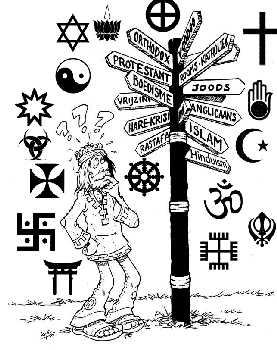
-Swami Vivekananda
Empower yourself with knowledge and change your interpretation of religion and the world that surrounds you to something you, yourself can derive from your scriptures... Don't let anyone else dictate what is right or wrong. Judge a human for what she/ he is and not for what she/he looks like or what background she/he hails from. No religion preaches violence.
What does Muslim mean?
Musallam- eemaan, jiska imaan har haal main kayam hai.
Musallam- eemaan, jiska imaan har haal main kayam hai.
i.e. The one who is true to his/her faith in every situation....
Well, doesn't that make many of us Muslims in a way?
Well, doesn't that make many of us Muslims in a way?
But, going by the title of this post, which one are you?
Now, I know this is quite a controversial topic. There has been much debate about the same in recent times. I'll try to bring a liberal Indian perspective to it. But you could count it as my own personal perspective.
Let me start by placing a few questions in front of you and subsequently I shall be answering them.
Why Pakistan was created?
Power struggle between the Congress (INC) and the Muslim League(AIML), which had been propped up by the British to weaken the freedom moment with the aid of their Age old policy of 'Divide and Rule'. A divided subcontinent was conceived to be an asset for potential future Geopolitical maneuvers.(for the inquisitive: read Spykman's Rimland theory, its application causing the conflict of North and South Vietnam, North and South Korea, driving a wedge between India and Pakistan, furthering the Shia-Sunni divide in West Asia, Afghanistan problem, Iraq issue the list has no end)

The seeds of this policy had been laid down by Britain from the very beginning, right after the first effort of an united revolt by the Indians in 1857. Later adopted by the New Super Powers of the world.
Was it like this from the beginning?
Well, for around 500 years, Muslim rulers ruled different parts of Hindu majority India and in those many years, no single instance of communal riots between the common citizens was ever noted to have occurred. The exceptions being a few minor conflicts in the beginning...during the consolidation of the new empire. People had accepted one other and a homogeneous tolerant society had developed.
On the other hand all the wars during that period were given a communal hue for political gains by the Rulers because religion was the common uniting factor and it gave spark to the suppressed emotions. So that, a soldier would even give up his life to save his religion, his God. In that era religion was very deeply ingrained in the socio-economic and political life yet, each followed his own religion without interfering into the other's. In fact, most wars portrayed as conflicts between Hindu rulers and their Muslim counterparts, had contingents of warriors of both religion ad other religions too on each side. (There are well documented evidences, but you need to take the pain of searching them.)
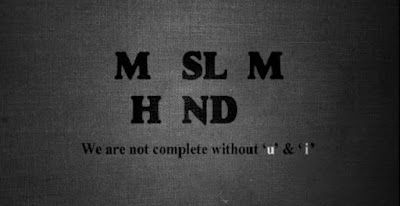

Urdu, in fact, was born in India and along with the other unique forms of art and architecture is a fine example of Indo-Islamic cultural synthesis.
So, the Big Question.
Why did this Communalism start in India?
Why did this Communalism start in India?
Communalism is a modern phenomena, deeply rooted in the socio-politico-economic colonial structure. It emerged out of modern politics based on mass mobilization and popular participation.
If I have to put it in two simple words "Economic disparities." There might be many minor reasons which added to the cause, but this was the root of all the problem.
It all started in 1835… with the Declaration of Macaulay. It was about the introduction of "modern education" in India in English medium.( For the sake of cutting costs to increase profits of the East India Company. Services of the educated Indians would be a cheaper substitute for the high pay cheques of European Clerks.)
As most of us familiar with India, must be aware Hindus have castes within themselves, which are completely dedicated to education. They'll sacrifice everything for education like, the Kayastha (Scribes) community and Brahmins (Priests). For them education is the almighty, they will sell whatever they have, live in abject poverty and go through any hardship flung at them for the sake of attaining knowledge.
Hindus therefore welcomed the English medium education with arms wide open and subsequently got the government jobs in an age when there were no well paid stable jobs. The job shortage could also be attributed to the fact that, the Indian princes defeated by the British could no longer employ or patronize as many Indians, as they used to when they were independent and the murder of the Indian cottage industry to give impetus to the British goods.
This lead to birth of an enlightened, aware middle class in the Hindus as they were exposed to the new Western education, subjects and ideas of rationalism, humanism and scientific temper.. that had first emerged during the renaissance of the West.
For any society to progress, this is the class which makes the greatest contributions. The lower and upper class have limited scope because there is either too less or too much at their disposal, for them to take an initiative. Coming back, the Muslims refrained from embracing this new revolution. So, the case so emerged that, they got no government jobs and hence no middle class was formed, leaving most(not all) of the Muslims out of the path of progress.
This might also have been a ploy of the Muslim elite to stay in power because if a well informed middle class emerges from within them, who would then pay heed to their words?
The Muslims would have had the capacity to think beyond and make their own choices. To add to this factor, the British were initially anti-Muslim in outlook right after the 1857 revolt as they held Muslims to be the main culprits for the revolt. (A stand they later changed to help their own cause by misguiding secular Muslims into radicalism and encouraging communal politics in Muslims.= establishment of The Mohammedan Anglo-Oriental College and formation of All-India Muslim League)
The Muslims would have had the capacity to think beyond and make their own choices. To add to this factor, the British were initially anti-Muslim in outlook right after the 1857 revolt as they held Muslims to be the main culprits for the revolt. (A stand they later changed to help their own cause by misguiding secular Muslims into radicalism and encouraging communal politics in Muslims.= establishment of The Mohammedan Anglo-Oriental College and formation of All-India Muslim League)
This economic disparity gave spark to the conflict between the Hindus and the Muslims.
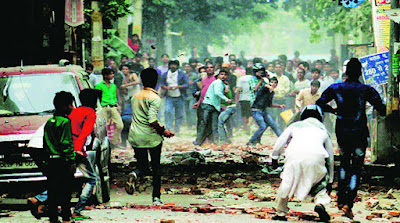 One fine example can be seen today in Syria, where most of the population are adherents of Islam, yet they have frequent clashes. The reason is that the economically and politically powerful minority (Shia) control the country of a majority (Sunnis). Similarly, in the case of the formation of Bangladesh out of Eastern Pakistan, the powers in West Pakistan had dominated the Bengali's of East Pakistan, treating the Bengali speaking minority population as second class citizens.
 One fine example can be seen today in Syria, where most of the population are adherents of Islam, yet they have frequent clashes. The reason is that the economically and politically powerful minority (Shia) control the country of a majority (Sunnis). Similarly, in the case of the formation of Bangladesh out of Eastern Pakistan, the powers in West Pakistan had dominated the Bengali's of East Pakistan, treating the Bengali speaking minority population as second class citizens.
The previous two examples are just one among the many that prove religion is not the reason for the conflict. Conflicts have always been and would always be there, when one set of individuals try to impose or force their ideology on the other. While they should actually put their efforts in convincing the others about the merits of their own ideology in a positive manner.
It is just a bad coincidence that it is Muslims in Myanmar, India, China, Palestine or elsewhere who suffer. But any population being exploited have themselves to blame for their situation. If they accept knowledge and scientific temper as the supreme truth instead of listening to their orthodox priests and their radical ways whose main objective has always been to maintain their clout over the masses of their own community through violence instead of empowering the masses by encouraging productive, progressive education and work. All religions are plagued by this orthodox radicalization problem. In fact, those Indians irrespective of them being Muslims or not, who have embraced education and have abstained from orthodoxy, following their own interpretation of their religion are doing pretty well and are the reason behind the gap between say, India and other countries who got independence at a similar time.
Despite majority of India's population and regions going through innumerable problems related to differences from religious, linguistic, caste, etc and infrastructural bottle necks it has emerged to become one of the fastest growing economies when big economies like USA, China, Japan and Germany despite being strong are on shaky ground today. Can we not imagine if we iron out these petty and unproductive problems, we all could live in a much more peaceful environment, without fear... A peaceful, conflict free life is all that most people dream of and pray for.
Despite majority of India's population and regions going through innumerable problems related to differences from religious, linguistic, caste, etc and infrastructural bottle necks it has emerged to become one of the fastest growing economies when big economies like USA, China, Japan and Germany despite being strong are on shaky ground today. Can we not imagine if we iron out these petty and unproductive problems, we all could live in a much more peaceful environment, without fear... A peaceful, conflict free life is all that most people dream of and pray for.
What do I know about Islam?
Well, to be honest not much, but I think I have a sufficient understanding of its values. Everything Islam had in it's initial unadulterated form was good.(same for all religions when they began) In fact, they were the most progressive individuals around, when Europe and India were going through their respective, dark ages and stagnation by caste system. Arab Muslims were the people who learnt the greatest mathematical and scientific discoveries from Indians and preserved them till Europe emerged out of the dark ages to propagate it further. Without them, I presume the amount of progress and prosperity the world is witnessing today, especially in the fields of maths, engineering, science and technology, wouldn't have been possible. We all owe them!
The Shariat law was not made to seem inhuman & barbaric without a reason. It was made so because, it would have acted as a deterrent for people to even think of doing a crime. Linking it with religion made majority of the population think of it as an obligation to the divine, not to commit a crime.
Islam prohibited loans with interest for a noble reason. To prevent conflict because once one doesn't repay it, it spoils relations between the borrower and lender be it a family member or a close friend or anyone for the matter of fact. It also prevented exploitation of others for one's own profit.
The brotherhood of Muslims was created to stop conflicts. So that, people could live peacefully, treat everyone equally but unique to India even Muslims have castes, discriminating each other by the kind of jobs they do. Sadly due to orthodoxy, lack of self introspection and the wrong interpretations of heretics the words of Allah Sunnatullah through the great Prophet Muhammad have been lost in or got deteriorated with time...

I still get to read about multinational companies, factories, etc denying a person a job because he is a Muslim or not willing to rent their house to Muslims. Stating ridiculous reasons like they don't have a problem with the person being a Muslim but the real problem is them eating non-vegetarian food. While their own kids hide from them and have non-vegetarian food with their friends. Muslims being lynched for undue reasons. Muslims subject to embarrassing pat-downs(frisking) at the Airports or elsewhere. Suspicious glances for their beards, skull caps, hijabs, etc. The problem is worse for a Kashmiri Muslim. Not only do they get harassed and discriminated by people from other religion, even Muslims from other regions prefer not to have anything to do with them. @thanks to terrorism in J&K.
And we wonder why Kashmiri separatists have any support?
Kashmiri muslims feel unwelcome in other parts of their own country. Not just India, things are so anywhere in the world for a Muslim in USA, Israel, UK, France, Germany, Australia, China, Myanmar, etc maybe not always but at some point of time or other. If this constant bias goes on even the good Muslims might become vulnerable with all that frustration built up, to be easily brainwashed by radicals that, the whole world is conspiring against Islam. Our actions might just turn it into a vicious cycle.
Any major incident(you know of what type!) and anyone could very well anticipate, next thing who will be pointed out at and blamed for it...
The choice is and has always been ours, it is individuals who make up this society and not the other way around. So choose wisely, educate others before their misconceptions cause more problems!
True secularism is best depicted in Dr. Abdul Kalam.
When religion is one of the biggest issues in the subcontinent he, stood apart. He had respect from people of all faiths alike. I don't think his religious belief became a barrier for his career or for his approach towards other people. He considered it a personal affair and treated all alike as humans and in turn was treated and respected in the same manner by others too. Maybe he never mentioned it but I am sure he must have also felt some discrimination at some point in his life but he never brought it up, therein lies his greatness.
 Imagine the, communists, the leftist and the rightist, the Hindu nationals, the Orthodox Islamic & Sikh outfits, the high commissioner of Pakistan, the mostly anti-Tamil Sinhalese government alike everyone came to pay their last respects to him. The sense of loss Indians & others felt at his demise transcends division of caste, region, religion, language, political affiliation or even nationalities.
This emotional unity in an extremely diverse India is rare in peacetime.
When religion is one of the biggest issues in the subcontinent he, stood apart. He had respect from people of all faiths alike. I don't think his religious belief became a barrier for his career or for his approach towards other people. He considered it a personal affair and treated all alike as humans and in turn was treated and respected in the same manner by others too. Maybe he never mentioned it but I am sure he must have also felt some discrimination at some point in his life but he never brought it up, therein lies his greatness.

This emotional unity in an extremely diverse India is rare in peacetime.
India's defacto norm is acceptance and taking the best of the rest and changing with changing times. Only when you are progressive, open to new ideas can you survive and be successful, not just for others to look at but from within.
Indians have no particular racial type they just have tendencies toward different racial groups. Over time this became rigid and separate identities developed. In order to make our society truly inclusive we should take some lessons from our early ancestors. Great, adventurous people who let their bloodline mix so much. :P
Hence get out there and marry some person from a completely opposite background. That's how we will have a strong, united, unique and progressive culture.
Can I ask you a few questions?
Muslims believe that all Muslims are equal in the eyes of Allah that no Muslim is superior or inferior, the concept of universal brotherhood, but why is it not so for women? Are they not Muslims are they inferior Muslims, are Shias inferior to Sunnis? Is any pious, good human being who believes in god and lives a humble, honest life not a Muslim himself? No matter by what name he addresses his God as.
As for Hindus, they believe that God is part of all humans and he is omnipresent, but if they were true to their belief why don't they ever incorporate it in the real world? In that sense even Christians, Muslims, Jews, Buddhist, etc have God in them. But before that the women, dalits or shudras also have God in them. Why not accept that?
As for Hindus, they believe that God is part of all humans and he is omnipresent, but if they were true to their belief why don't they ever incorporate it in the real world? In that sense even Christians, Muslims, Jews, Buddhist, etc have God in them. But before that the women, dalits or shudras also have God in them. Why not accept that?
What can we do?
It really needs nothing more than common sense and open mindedness... Most conflicts in the world are because we don't see what is there right in front of us, we don't listen to what our conscience says and instead we choose to listen to some orthodox, obnoxious hypocrite who is a self proclaimed authority in all matters of our relidio-spiritual life.
Personally I do NOT believe that any religion is superior to another, they are different routes to the same destination. Like, 'life ultimately ends with death, it is up to us to choose which path to follow to our final destination.' Of course sometimes circumstances do force us to choose a path not of our liking, but that is not always the case. If someone really wants to show his religion is superior why not just show your respect and acceptance of other religions and their beliefs. I am sure someone who sees these qualities would himself want to convert to your religion and won't need violence or economic sops to do so. The latter two can make a person switch sides as a matter of time and circumstances while the former method would be a more permanent conversion.


PS: So far, most of what I have written in this post and the earlier ones has been limited to Muslims and Hindus, because being an Indian these are the two major communities that you come across. If you are wise enough you can relate to this, no matter which religion you follow or which region of the world you belong to.
I never intended to offend anyone by this post, It is my own personal perspective and I am open to your differing views, if any.
http://theworldthroughtheeyesofthewhitetiger.blogspot.com/2015/11/good-muslim-bad-muslim-the-real-musallmaan.html
This is my effort to spread the message. In case you like it, please share the link ^.^ with as many as you can. Let's make it the Secular Jihad !